
-
Menu
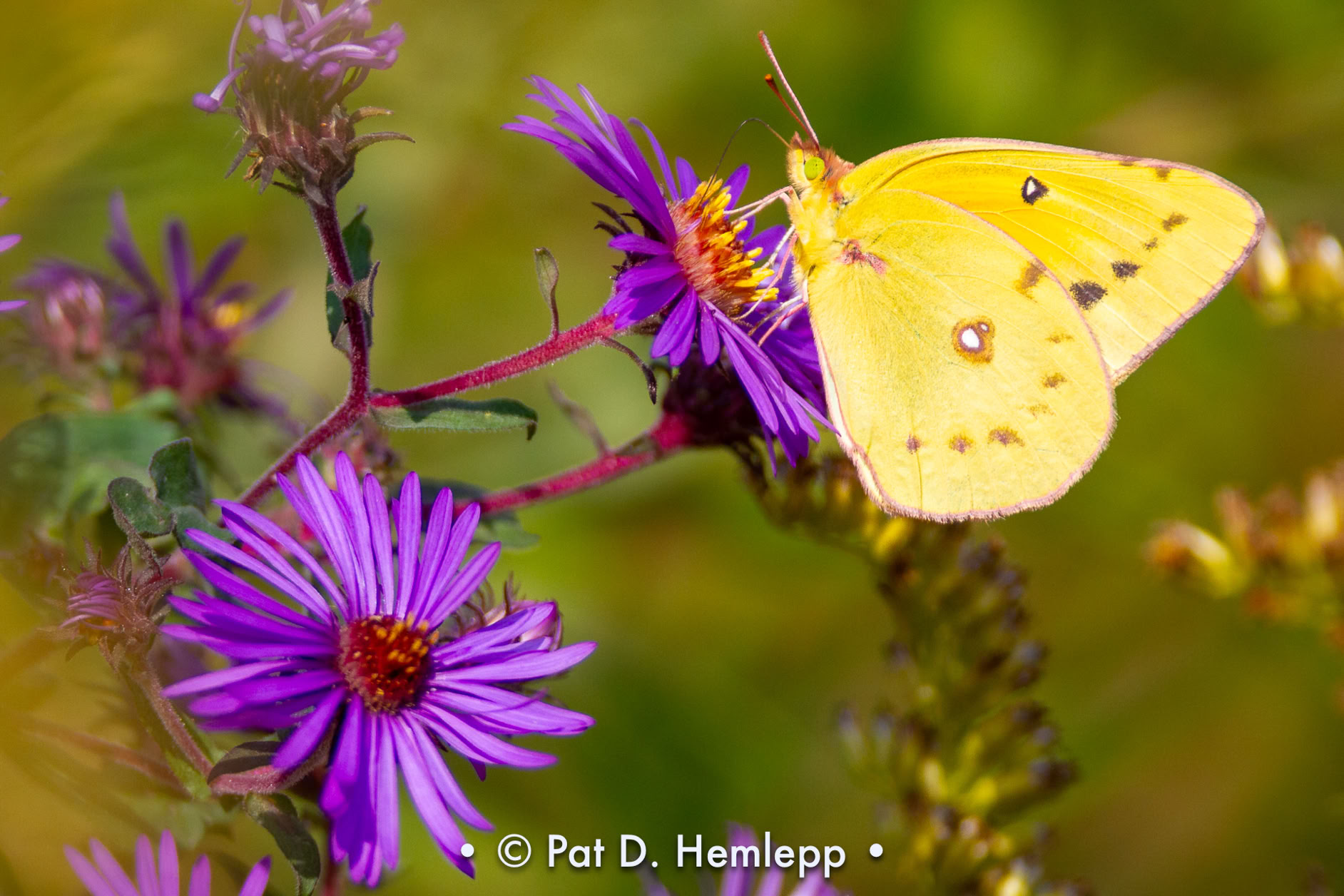
A clouded sulphur butterfly rests on a purple New England aster in Sharon Woods Metro Park, Westerville, Ohio.
I have a number of butterfly photos in my files. I consider each to be a lucky accident because I never set out to photograph butterflies. But if I encounter a butterfly in the right spot (on a plant close enough to get a good shot and with an uncluttered background that allows the butterfly to stand out), I’ll get the shot.
That’s why almost all of the butterfly photos in my files were captured using the Canon EF 600mm f/4L telephoto lens I carry when I’m photographing wildlife. It’s a massive lens, almost 18 inches long and weighing about 11 pounds (not including the camera and any other attachments), and it works very well when photographing birds. But if I run across a butterfly in an interesting setting while I’m shooting wildlife, I’ll go ahead and get the shot.
Most of my butterfly photos show monarchs, which are plentiful in central Ohio during the summer and early fall. But I also have a number of photos of zebra swallowtails, tiger swallowtails, black swallowtails, and others that I run across during my photo hikes.
This is a photo of a clouded sulphur butterfly, a variety I see somewhat frequently but have managed to capture very few usable photos. The reason is simple: The clouded sulphur is tiny. Its wingspan is typically under two inches, or about half the wingspan of a monarch. So when it rests on a plant with its wings closed, the profile is less than an inch.
It’s extremely difficult to get an uncluttered shot of something about an inch tall resting at some distance from my location.
But I was fortunate this time.
I had watched the tiny butterfly moving from plant to plant in a local field as I was looking for birds. With each hop the clouded sulphur made, it moved a bit closer to where I was standing, so I pointed my camera at it and started tracking. After a couple of minutes, the butterfly landed on a bright purple New England aster. There were no plants obstructing my view.
The clouded sulphur’s position and the colors in the scene were perfect. It’s one of the best-looking lucky accidents I’ve had.
This is likely a male clouded sulphur because the underside of the wings is yellow. The female tends to be more of a yellow-white or greenish-white. The underside of the wings on both male and female clouded sulphurs has a row of small brown spots. The underside of the hind wing usually has a silver spot surrounded by pink.
Clouded sulphurs usually land with their wings closed, so it is difficult to get a view of the tops of the wings. Male clouded sulphurs have black borders on all four wings on the upper side. The female has yellow spots in the black border.
Tech specs