
Tech specs
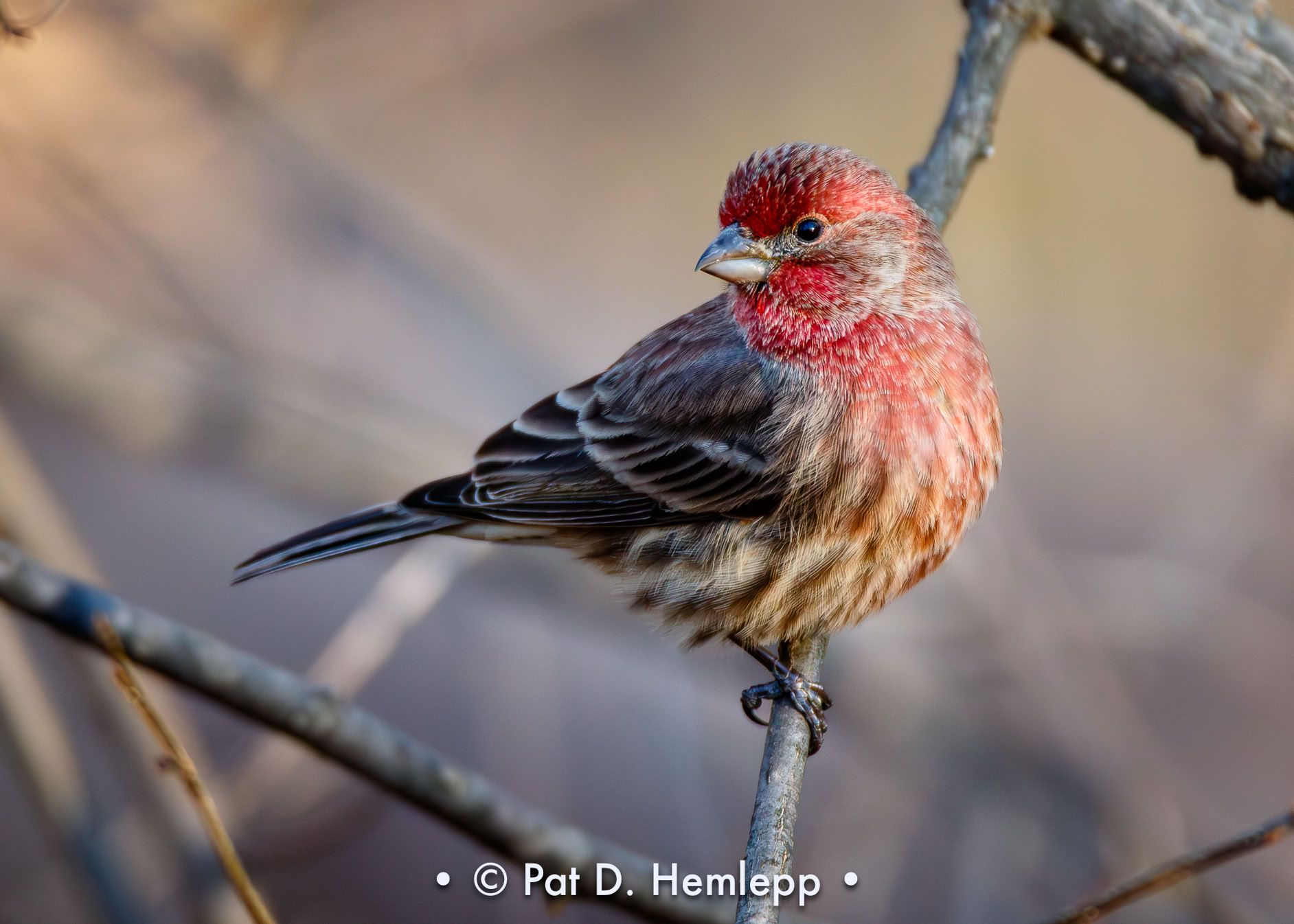
A male House Finch looks back while perched on a branch in Sharon Woods Metro Park, Westerville, Ohio.
I see a lot of House Finches in our area of Ohio, like this male House Finch perched on a limb on a winter morning in Sharon Woods Metro Park north of Columbus. But I didn’t know the birds aren’t native to this area until I was doing some research a few years ago before posting another House Finch photo.
The House Finch is native to the western United States and Mexico, according to my favorite source for bird information, All About Birds. Someone attempted to sell House Finches as cage birds in the eastern United States, calling them “Hollywood finches,” but when that effort failed a small number were turned loose on Long Island, N.Y., in 1940. Within no time the birds spread across the eastern U.S. and southern Canada, with an estimated population in North America of between 267 million and 1.4 billion.
Male House Finches have rosy red faces, chests and rumps. When I see one in flight in my peripheral vision, the red is so conspicuous that my first reaction is “cardinal” until I get a better look. Females are less eye-catching, with grayish-brown feathers without a trace of red.
According to All About Birds, "The red of a male House Finch comes from pigments contained in its food during molt (birds can’t make bright red or yellow colors directly). So the more pigment in the food, the redder the male. This is why people sometimes see orange or yellowish male House Finches. Females prefer to mate with the reddest male they can find, perhaps raising the chances they get a capable mate who can do his part in feeding the nestlings.”
Some may confuse the male House Finch with the somewhat-similar male Purple Finch. The reddish or orange-red coloring on the male House Finch is limited to the heads and chests with a bit on the rump. Male Purple Finches are more raspberry-red or purplish, with the color on the heads and chests, but also extending to their backs and sides.