
-
Menu
-
Home
-
Photo of the week
-
Featured gallery
-
Favorites
-
Recent photographs
-
About
-
Contact
-
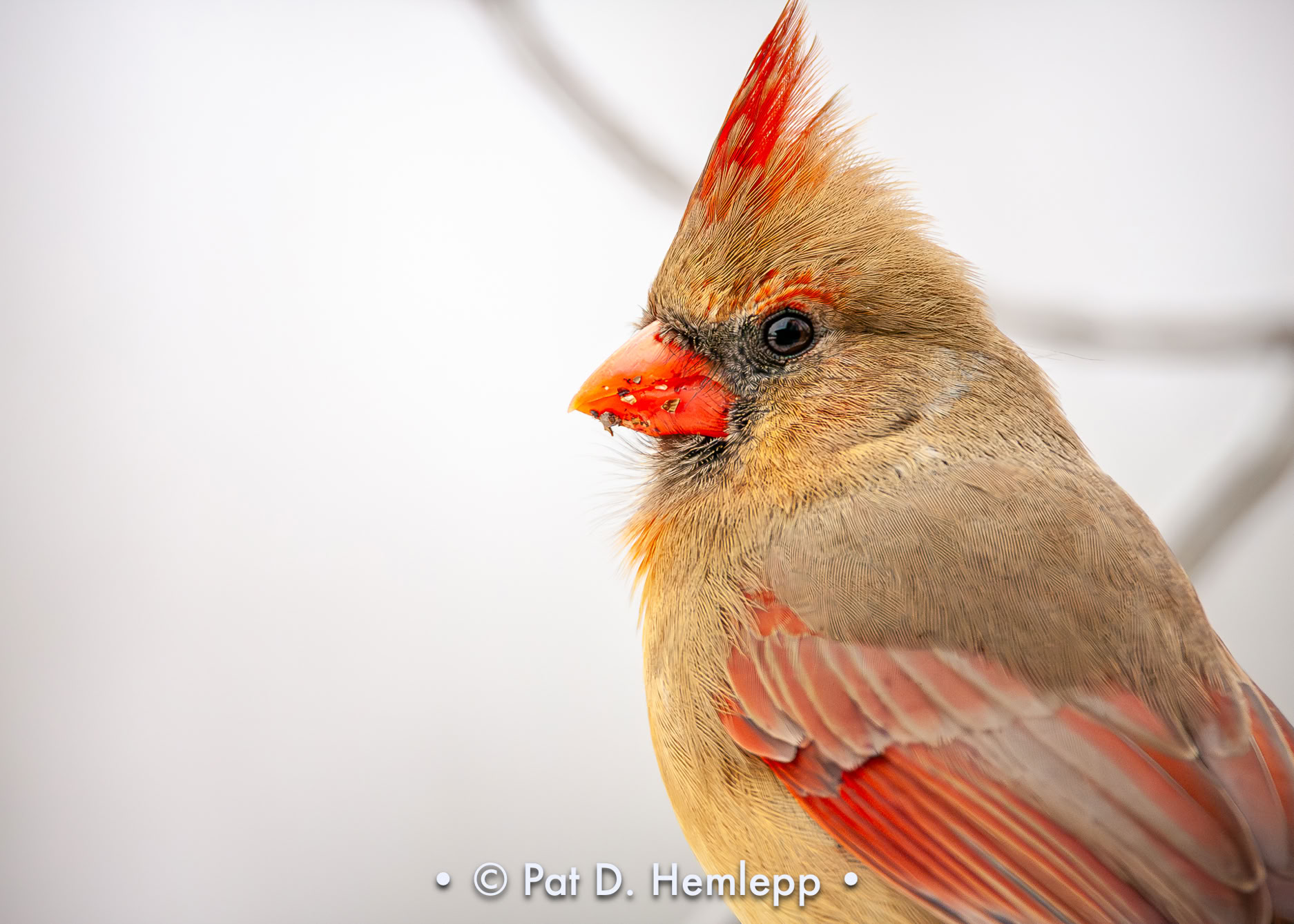
A female Northern Cardinal perches against a snowy background, Blendon Woods Metro Park, Westerville, Ohio.
Male Northern Cardinals are attention-getting birds, with their brilliant red feathers, red-orange beak, black face and sharp crest. You can spot the red easily in green trees and bushes during the summer or against snowy backgrounds during the winter since cardinals don’t migrate.
That’s not the case for the female Northern Cardinal. They are primarily a yellowish-brown with warm reddish tinges on the tail, crest and wings. The subdued colors blend with their surroundings, making them harder to spot.
I see cardinals in the summer but have very few photos of them with green leaves. That’s because cardinals are extremely shy birds, flying off quickly if they detect motion. There’s little to keep them in one spot when I approach in the summer.
The vast majority of my photos of cardinals are taken during the winter months in Blendon Woods Metro Park. The park has a viewing shed that provides bird watchers with a chance to watch a variety of waterfowl on a nearby pond during winter months (the pond has an aeration system so it doesn’t freeze solid in the winter).
The park also has a well-stocked bird feeder to the side of the shed. That’s why I go.
I use the shed as a photographer’s blind, keeping me out the birds’ sight while protecting me from wind and snow (the shed isn’t heated, so I have to deal with the cold). Cardinals, nuthatches, chickadees, titmice, a variety of sparrows, woodpeckers, Blue Jays and a number of other species queue up on surrounding limbs, bushes or fallen logs while they wait for a spot at the feeder. That’s when I get my shots.
Winter in Ohio tends to be extremely gray— dreary, overcast skies result in dreary, dim lighting and poor photos — so I often set up several flash units on wireless remotes when I’m shooting at Blendon Woods. I aim the flashes at areas where I anticipate seeing birds and set the exposure so the flash supplements the available light instead of serving as the primary light source.
In this photo, a female cardinal was perched on a tree limb overlooking the feeder, very close to the opening in the viewing shed. The cardinal was so close to my location that I could only see its head and shoulders through the viewfinder, kind of like a portrait setting. A recent heavy snowfall blanketed the surrounding forest on the December morning, providing an uncluttered background. I exposed for the snowy background, allowing the flash units to balance the lighting on the bird in the foreground with the light background.
I like how the photo captures the bird’s feather details, including the extra tinges of red around the eye.
Tech specs